
How to Start a Valet Trash Business (2026 Guide)
Valet trash — nightly doorstep trash collection at apartment communities — is one of the few service businesses you can start with a vest, a route, and a single contract. Property managers sign multi-year agreements, revenue recurs monthly per door, and the startup costs are a fraction of almost any other contracting trade.
This guide is the version we wish existed when the operators we work with at Doorstep One were starting out: practical, numbers-first, and honest about the parts that are harder than the YouTube videos make them look. No course to buy at the end.
How the business works
The model is simple:
- A property manager (PM) contracts with you to provide doorstep collection, typically five nights a week. Published industry pricing guides put operator billing at roughly $8–$15 per door per month (Impact Trash's 2026 pricing guide, National Trash Valet).
- The property charges residents for the amenity — commonly $25–$35 per unit per month, often as a mandatory line item on rent. The spread is the property's ancillary revenue, which is why PMs like the amenity.
- Your porters collect bagged trash from each doorstep during a set-out window (usually 8 PM onward), carry it to the compactor or dumpster, and note any rule violations.
At the middle of the billing range, a single 200-unit community is worth over $2,000/month in recurring revenue. Five communities is a real business. Fifty is a company.
Step 1: Understand your startup costs
You don't need a warehouse, a fleet, or heavy equipment. A realistic startup budget:
- Business formation and insurance — LLC filing, general liability insurance (most property management companies require $1M coverage before you set foot on site).
- Containers — branded 13-gallon containers for each unit if your contract includes them.
- Porter gear — reflective vests, gloves, a shoulder valet bag or cart per porter.
- Software — route management, photo proof of service, and property manager reporting.
Most operators can get started for well under $10,000, and many start under $5,000 with a single small property. The biggest cost isn't capital — it's the months of business development before your first contract signs.
Step 2: Write a one-page plan around unit economics
Skip the 40-page business plan. What a lender, a partner, or your own sanity check actually needs fits on one page:
- Revenue per door per month you'll bid (start from the $8–$15 published range and price to your market — the valet trash pricing guide breaks down what pushes a bid up or down).
- Porter labor — the industry's dominant cost. As an illustrative planning assumption, try roughly $35–$60 for a porter servicing a route-night, then replace it with your own route pay.
- Route math — how many doors one porter can service a night at your properties' layouts (garden-style walk-ups service faster than towers with slow elevators).
- Break-even doors — how many doors under contract cover your insurance, software, and gear.
If those four numbers work, the business works. Everything else is execution.
Step 3: Get insured and legal before you pitch
Property management companies won't sign without:
- General liability insurance (typically $1M per occurrence; have the certificate ready to send with your proposal)
- An LLC or corporation — nobody signs a services agreement with an individual
- Workers' compensation where required, once you hire porters
Do this before your first pitch meeting. "I'll get insurance once you sign" ends pitches.
Step 4: Win your first contract
This is the hard part, and it's a sales job. What works:
- Pitch the property manager's problems, not your service. PMs care about resident satisfaction scores, ancillary revenue (NOI), and not fielding complaints. Valet trash scores on all three.
- Lead with verification. The national providers have spent years teaching PMs to demand photo-verified service — then delivering it inconsistently enough that missed pickups are their most common public complaint. Walk in showing your nightly photo proof and morning report, and you're competing on service quality instead of company size.
- Start with the property nobody wants. A 100-unit community that's too small for the nationals is the perfect first contract. Deliver flawlessly for six months and you have a reference — and PMs talk to each other constantly.
- Check who manages the property before you pitch. Communities run by national management companies are usually covered by portfolio-wide contracts with national valet trash providers — signed at corporate, far above the local manager you'd be pitching. No amount of proof wins a door that isn't the local PM's to give. Your winnable market is independently owned and managed communities, local and regional management companies, and portfolios that don't offer valet trash at all. That last group is the best first pitch in the business: a local portfolio with no valet trash program means no incumbent to displace and one decision-maker who can say yes to several properties at once.
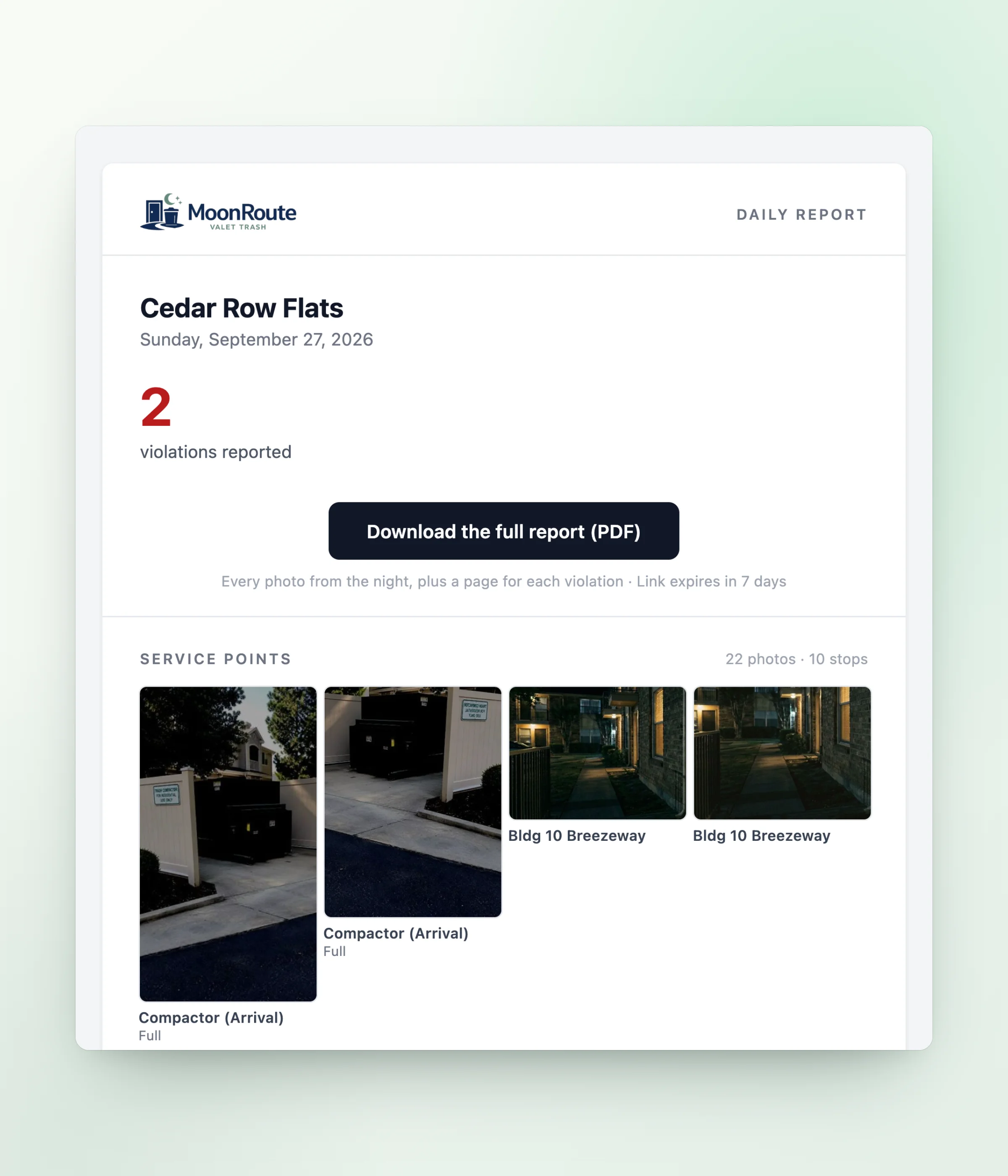
- Put your proof in the proposal. A sample morning report with photo evidence closes more deals than a brochure ever will.
Step 5: Run night one like a professional operation
The failure mode for new operators isn't landing contracts — it's the slow slide into chaos once they have three properties: routes in a spreadsheet, porters coordinating over group texts, violations on paper, and a PM asking "did you actually service last night?" with no answer.
Set up the system before you need it:
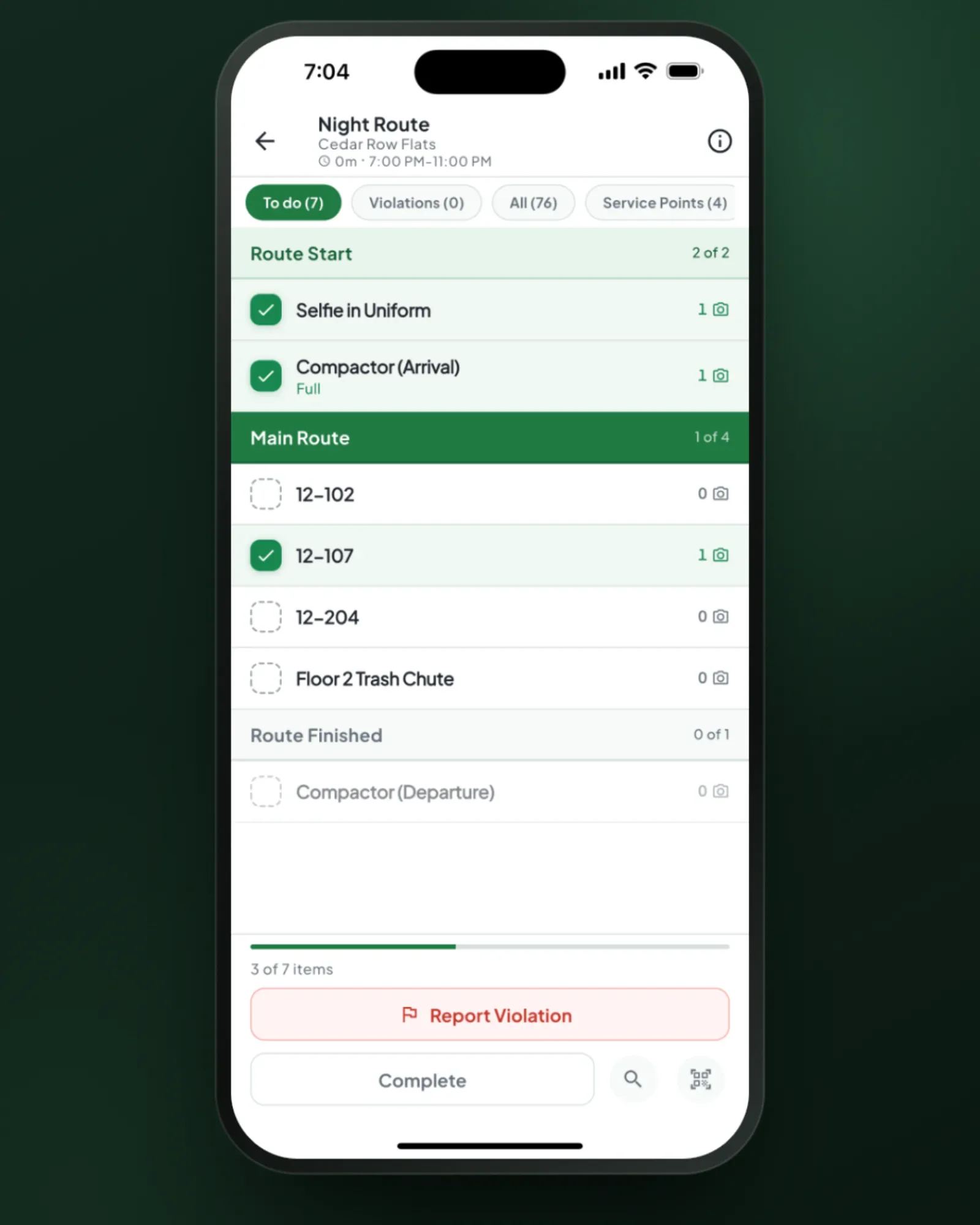
- Routes and schedules in software, not spreadsheets — so a porter no-show at 9 PM is visible immediately, not the next morning.
- Photo proof of service for the doors and service points you choose, stamped with time and location, and a flag when a required photo is missing — your answer to every dispute.
- Automatic morning reports to every property manager, sent once the night's routes are done — the single highest-leverage retention tool in the business. A PM who gets verified proof every morning has no reason to take competitor calls.
- A login for every property manager — give every property manager their own free login and the property's automatic morning report, however many managers the property has.
- Violation documentation with photos — protects the property's rules and generates the paper trail PMs need with residents (the valet trash violations guide covers how to document them so they hold up).
This is exactly what Doorstep One's valet trash software for entrepreneurs does, and it's why we let you start on the same platform that runs 109,000+ doors nightly — professional rails from your first route. See our simple per-seat pricing; every account starts with a one-month free trial.
Step 6: Hire porters you keep
Porter turnover is the industry's quietest killer. What keeps porters:
- Organized routes with clear expectations — nobody stays at a job that's nightly chaos
- Fair, transparent pay — a clear rate for each route-night they can check against the nights they worked
- Good tools — an app in their language (a large share of the porter workforce is Spanish-first) that works in dead-signal breezeways
- Training on real routes — pair a new hire with a trainer on the same route: everything the new hire logs is credited to them, and you can pay them a set amount while they learn. That's what team routes are for; one porter per route is still the simplest setup for most properties.
The honest downsides
- It's night work. Five nights a week, in weather, around dumpsters. Your porters carry that, and managing night-shift labor is a real skill.
- Contracts concentrate risk. Losing one 300-unit property can be a third of your revenue. Verification and reporting aren't nice-to-haves — they're your renewal insurance.
- The nationals will bid against you on bigger properties. You beat them with service quality, responsiveness, and proof — not price.
Quick-start checklist
- Form your LLC and get a general liability quote
- Build your one-page unit-economics plan
- Set up your service platform (routes, photo proof, PM reporting)
- Build a target list of 20 local, independently managed properties (150–400 units, garden-style first)
- Create a sample proposal with a real morning report
- Pitch, deliver flawlessly, and ask for referrals at month three
Billing and resident-fee ranges above come from published industry pricing guides linked inline; the porter cost range is an illustrative planning assumption. Your market may vary. Want the platform side handled from day one? See how Doorstep One works for new operators →
Frequently asked questions
- How much does it cost to start a valet trash business?
- Most operators can get started for well under $10,000, and many start under $5,000 with a single small property. The main costs are business formation and general liability insurance, branded containers if your contract includes them, porter gear, and software — and the biggest cost is usually the months of business development before your first contract signs.
- How much do valet trash companies charge per door?
- Published industry pricing guides put operator billing at roughly $8–$15 per door per month for standard five-night service, while properties commonly charge residents $25–$35 per unit per month for the amenity.
- Do I need insurance before pitching properties?
- Yes. Most property management companies require $1M general liability coverage before you set foot on site, and nobody signs a services agreement with an individual — form an LLC and have your insurance certificate ready before your first pitch meeting.
- What should my first valet trash contract be?
- A community that's too small for the national providers — around 100 units — at an independently owned and managed property. Deliver flawlessly for six months and you have a reference, and a local portfolio with no valet trash program at all is the best first pitch in the business.