
Valet Trash Pricing: What Operators Charge (and What It Costs to Deliver)
Most valet trash pricing content is written for property managers shopping for a vendor. This guide is for the other side of the table: the operator deciding what to bid, and the entrepreneur checking whether the math works. (Not yet operating? Start with how to start a valet trash business and come back for the numbers.)
The three prices in every valet trash deal
Valet trash has three price points, and confusing them is the most common rookie mistake:
- What the resident pays the property — commonly $25–$35 per unit per month, usually a mandatory amenity fee on rent (Impact Trash 2026 guide).
- What the property pays the operator — published guides put this at roughly $8–$15 per door per month for standard five-night service (Property Manager Insider, National Trash Valet).
- What it costs the operator to deliver — dominated by porter labor.
The property keeps the spread between 1 and 2. That spread is why the amenity exists, and understanding it makes you a better negotiator: you're not selling trash pickup, you're selling the property a profitable amenity plus the proof they need to keep charging for it.
What drives your bid up or down
Within the $8–$15 range, price to the property's real service cost:
- Layout. Garden-style walk-ups service fast. Mid-rises with slow elevators or long corridors burn porter-minutes per door. Bid the layout, not just the unit count.
- Nights per week. Five is standard; seven-night or twice-nightly service belongs at the top of the range or above it.
- Extras. Bulk item hauling, compactor-area cleanup, recycling sorting, and violation enforcement all justify add-on pricing — itemize them.
- Container provision. If you supply branded containers, amortize them into the first-year rate.
- Market. Sunbelt metros with dense multifamily stock are more competitive (and more price-sensitive) than secondary markets with no incumbent.
The cost side: porter labor is the whole game
Porter labor is far and away the dominant cost of delivery. As an illustrative planning assumption, try roughly $35–$60 for a porter servicing one route-night (then replace it with your own route pay), and check the math per property:
(porter cost per night × service nights per month) ÷ doors = labor cost per door per month
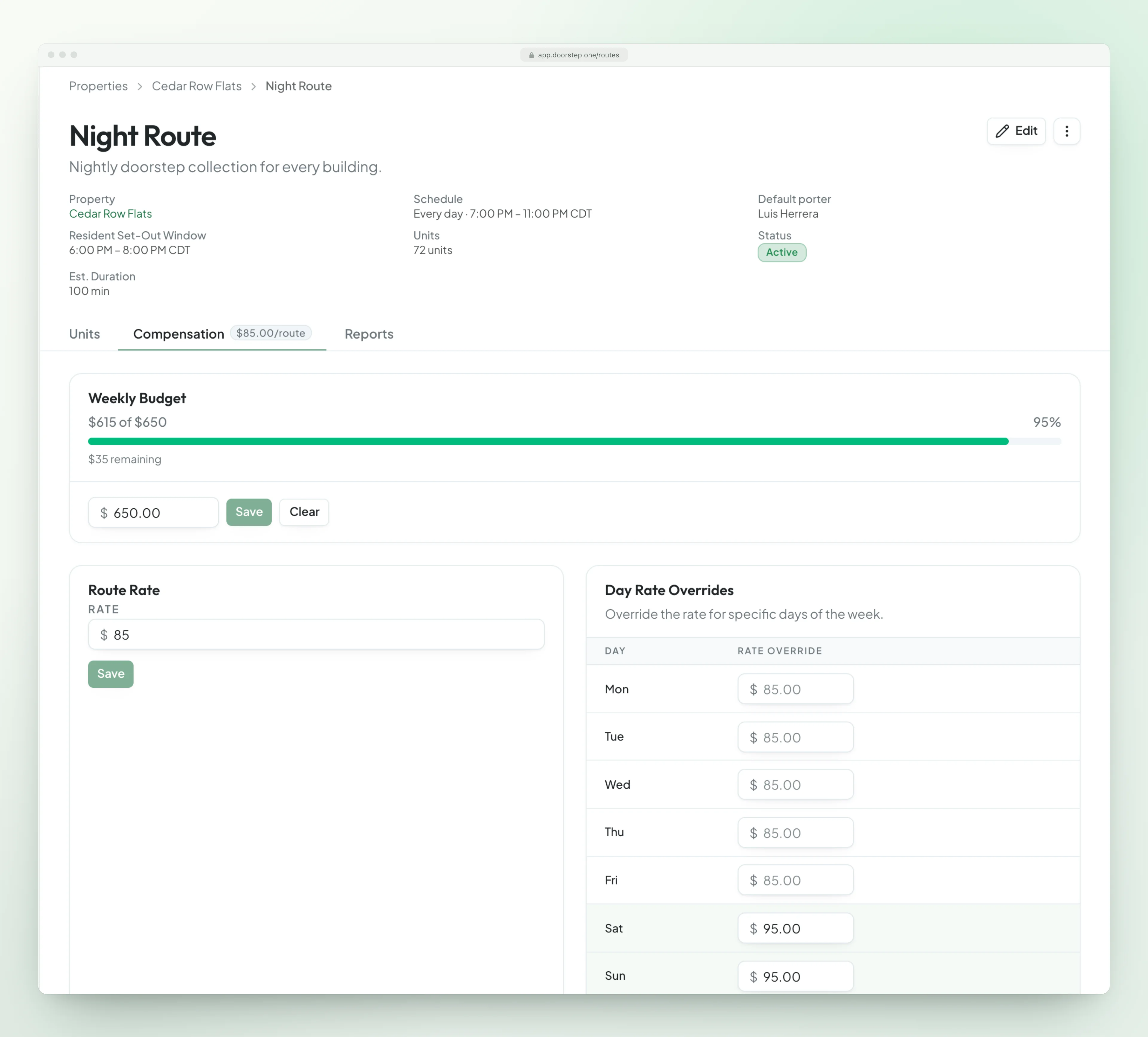
A property whose labor comes to $4/door/month and bills at $12/door/month is a healthy account. One that services slowly — bad elevators, scattered buildings, an oversized route — can quietly run at half the margin of the property next door. Per-property route economics are worth tracking from day one, because operators who don't usually discover their least profitable property only when a porter quits over it. Doorstep One records what every route-night pays your porters, route by route, so the labor side of that math is already there. And when a heavy night needs two porters, a team route splits that night's route pay between the porters who start, or you set an exact amount for anyone.
Beyond labor, the remaining costs are comparatively small: insurance, software, gear replacement, and payroll/admin time.
Contract structure notes
- Term: Multi-year terms are common and worth trading price for — a 200-unit property at mid-range billing is worth well over $20,000/year, and switching vendors is disruptive enough that incumbency is powerful.
- Per-door vs. flat: Per-door pricing with an occupancy floor protects you from lease-up seasons. Flat monthly pricing is simpler but transfers occupancy risk to you.
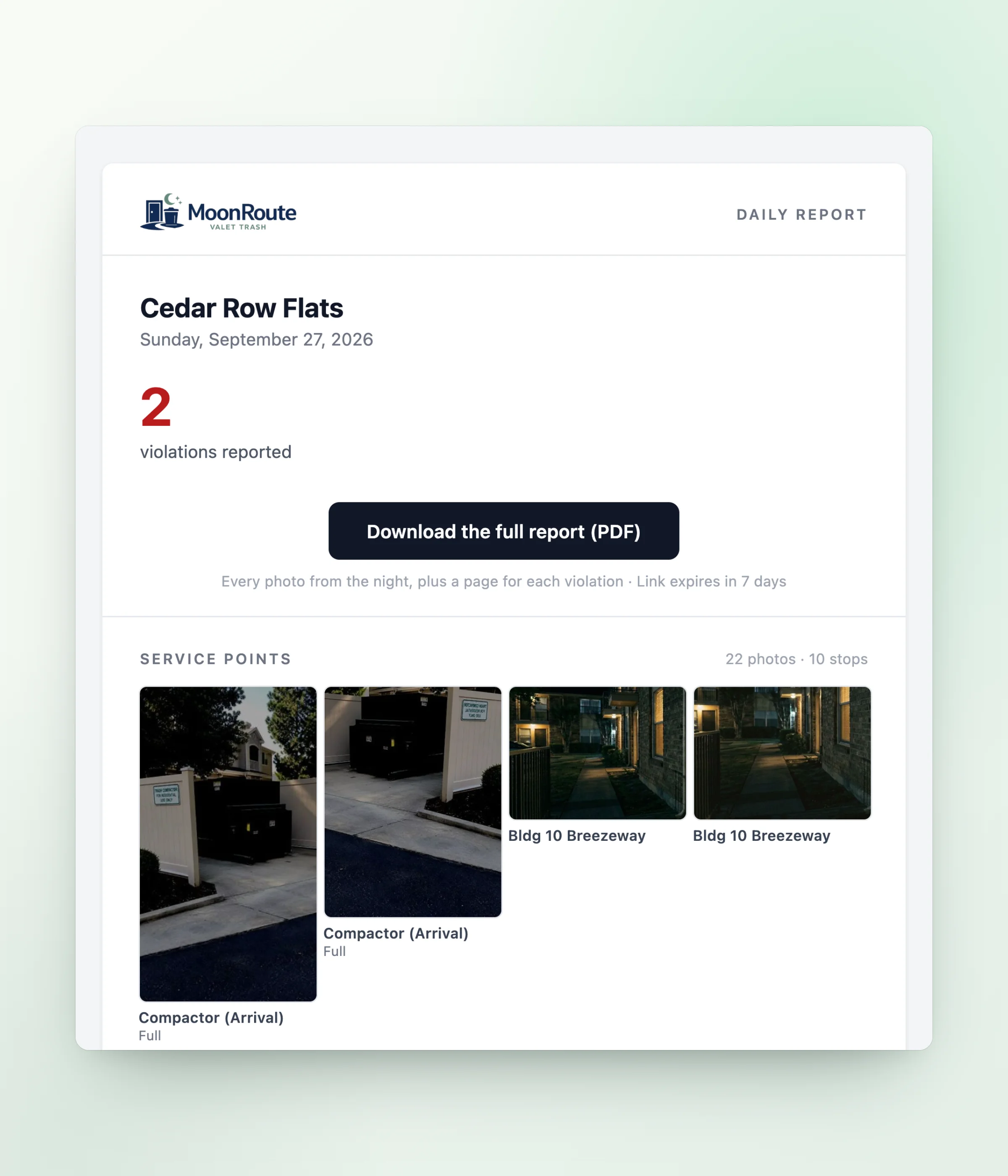
- Violation enforcement: Some operators bill violations separately or share violation-fee revenue with the property. Whatever you agree, it only works if violations are photo-documented — undocumented violations become disputes, not revenue. The valet trash violations guide covers documentation that holds up.
- The verification clause: Increasingly, RFPs ask for photo verification and reporting explicitly. Being able to say yes — with nightly photo proof and automated morning reports — moves you up the shortlist before price is discussed.
What about software costs?
Valet trash software pricing is all over the map: plans tiered by units, properties, or communities run $100–$1,199/month regardless of how small you are, and per-seat products range up to $49.99/seat/month (competitor pricing rechecked September 2026 — see our comparison). Doorstep One costs $39/active team seat/month, 22% below the $49.99 monthly seat price another valet trash platform publishes. Property manager logins are unlimited and always free. Annual billing is $32/seat/month. For a small crew, software should be a rounding error next to one door's monthly revenue.
Sanity-check example
A 250-unit garden-style community, five nights a week, bid at $11/door:
- Revenue: 250 × $11 = $2,750/month
- Labor: one porter-night in the $40s × ~21.7 service nights ≈ $950–$1,050/month
- Gross margin before overhead: roughly 60%
Run that same math on every property you bid — before you sign. If a property doesn't clear your margin bar at a winnable price, it's not a deal; it's a future problem.
Use the free valet trash profit calculator to replace the example assumptions with your own doors, price, service frequency, labor, and overhead.
Billing and resident-fee ranges come from the published sources linked inline (accessed July 2026); the porter cost range is an illustrative planning assumption. Your market may vary. Doorstep One records what every route-night pays your porters, route by route, so the labor side of that math is already there. See how operators use it →
Frequently asked questions
- How much does valet trash cost per door?
- Published guides put what a property pays the operator at roughly $8–$15 per door per month for standard five-night service. Residents commonly pay the property $25–$35 per unit per month for the amenity, and the property keeps the spread.
- What does it cost an operator to deliver valet trash?
- Porter labor dominates. As an illustrative planning assumption, try $35–$60 per porter per route-night, then replace it with your own route pay. Divide (porter cost per night × service nights per month) by doors for labor cost per door per month — the remaining costs (insurance, software, gear replacement, and admin time) are comparatively small.
- What drives a valet trash bid up or down?
- Layout (garden-style walk-ups service faster than mid-rises with slow elevators), nights per week, extras like bulk hauling and compactor-area cleanup, container provision, and how competitive the market is. Bid the layout, not just the unit count.
- Is per-door or flat-rate pricing better for operators?
- Per-door pricing with an occupancy floor protects you from lease-up seasons. Flat monthly pricing is simpler but transfers occupancy risk to you.