
Valet Trash Violations: The Operator's Guide to Documenting and Enforcing Them
Search "valet trash violations" and you'll find resident complaints and property rule lists. What you won't find is the operator's side: how to document violations so they hold up, how to report them so property managers act on them, and how violation handling quietly decides whether your contract renews. That's this guide.
Why violations matter more than they look
A violation — loose trash, an unbagged bin, hazardous waste at a doorstep — seems like a small operational annoyance. It's actually three bigger things:
- A liability question. Your porter skipped the unit for a reason. If that reason isn't documented, the resident's complaint becomes your missed pickup.
- A property-rules enforcement tool. The property's lease addendum sets the rules; your documentation is the only evidence trail the PM has when enforcing them with a resident.
- A service-quality signal. Violation trends tell a PM which buildings, floors, and units need resident education — data no clipboard process can produce.
Operators who handle violations well are more valuable to a property than operators whose routes never hit one, because every property has them.
The violation types worth tracking
Useful violation types distinguish one operational issue from another instead of collapsing everything into a generic note. A practical set often covers:
- Loose / unbagged trash — the most common; bags must be tied
- Bags outside the container — overflow beside the bin
- Overweight bags — a porter-safety issue as much as a rules issue
- Oversized or bulk items — furniture and boxes that aren't doorstep service
- Hazardous or prohibited waste — batteries, chemicals, glass, sharps
- Late set-out — bin out after the collection window
- Container left out — bins not retrieved by morning
- Improper container — non-provided or damaged containers
Each type identifies a specific rule or service condition and gives property teams clearer language for resident follow-up. "Violation: misc" documents nothing.
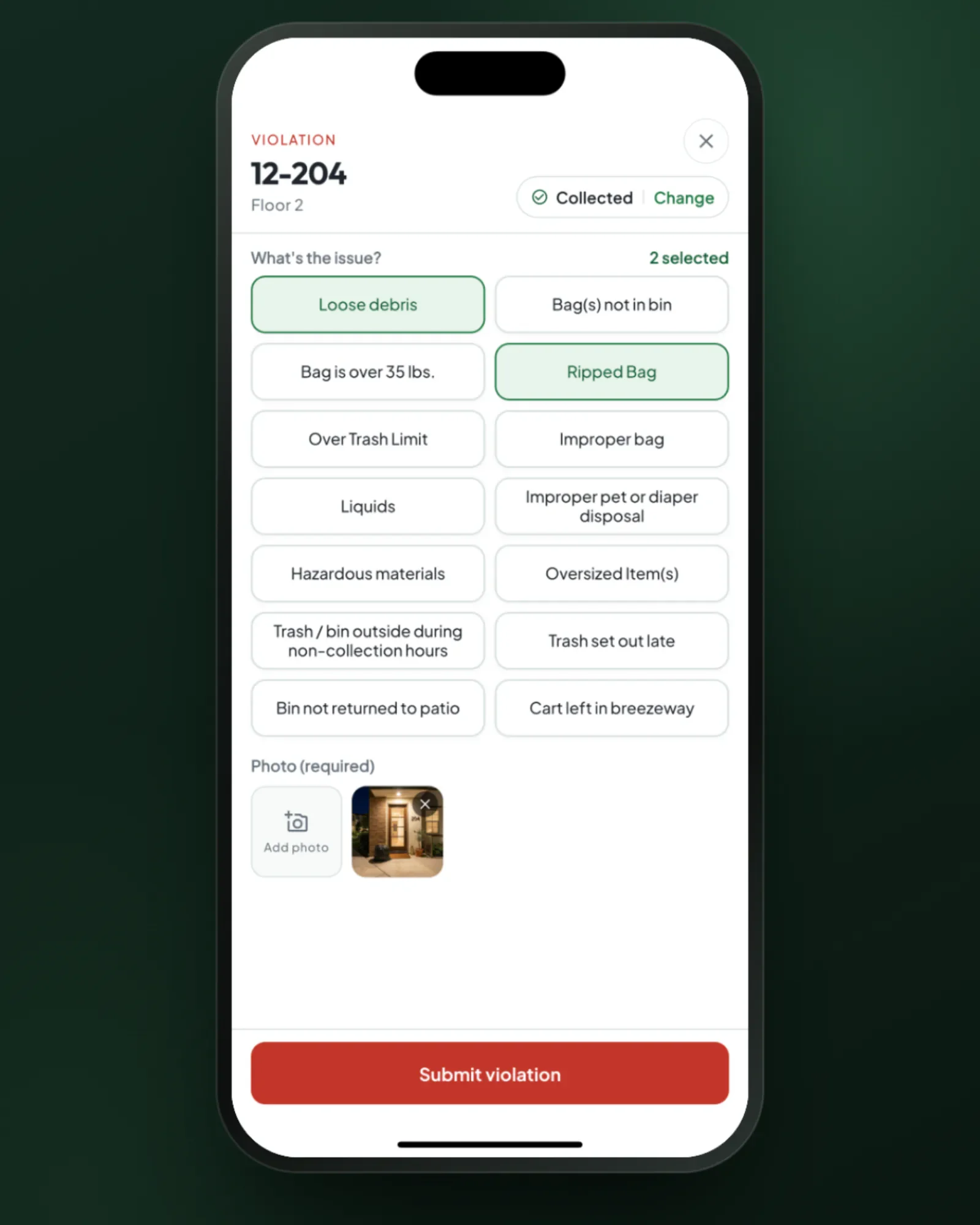
In Doorstep One, the list is yours: twelve starting reasons you can reword, retire, or add to, and past records keep the wording they were logged with. The porter also records what happened with the trash — Collected, Partial, or Not Collected — so the record shows whether the bag was taken or left.
Documentation that holds up
A violation record survives disputes when it has all five of these:
- A photo, required, not optional. No photo, no violation — make it a hard rule. The photo is the entire difference between evidence and hearsay.
- A timestamp and location captured automatically by the device, not typed by hand.
- The unit attribution — building, floor, unit — attached at capture time.
- The applicable violation type or types from a clear taxonomy.
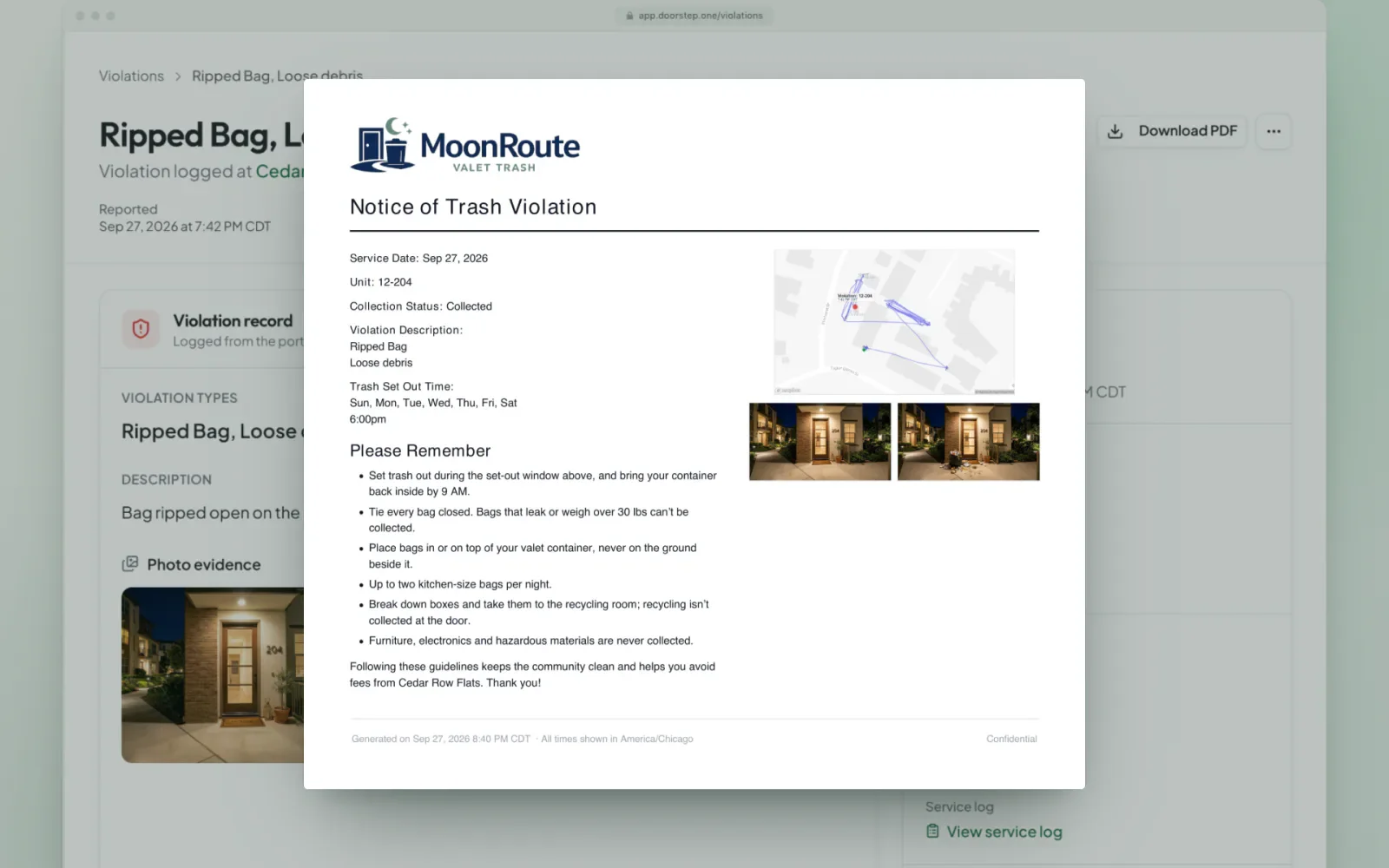
- A professional artifact — a PDF the property manager can attach to a lease-violation notice without reformatting anything. This is where clipboard processes and group-text photos die: the evidence exists but can't be used. In Doorstep One, every violation becomes a one-page PDF with your logo and your own heading and message, ready to hand to the resident.
One more layer most operators skip: make late edits impossible or visible. If a violation record can be quietly rewritten a week later, its value as evidence is gone. An audit trail that records every change, who made it, and when is what lets a PM trust the paper.
And never record the same problem twice. A double tap, an offline re-sync, or two porters flagging the same door should make one violation, so a resident is never billed twice for the same bag.
Reporting: violations belong in the morning report
A violation logged at 9:14 PM should be in the property manager's inbox the next morning — photo included, alongside that night's service summary. Batch-emailing photos on Friday teaches PMs that your documentation is an afterthought.
The morning report does three jobs at once:
- Shows the night's service evidence while proving rules enforcement (the violations)
- Gives the PM a forwardable artifact for resident conversations
- Builds the month-over-month trend line that justifies your renewal
Doorstep One's valet trash violation tracking workflow automates exactly this — photo-first violation records with your own reasons, the collection outcome, time, and location, plus a one-page PDF for the resident, delivered in branded property manager reports, with an org-wide audit trail. The same problem is never recorded twice.
Preventing violations beats documenting them
The most common violation is a late set-out, and the cheapest fix isn't enforcement — it's a reminder. Residents who get a push notification at the set-out window put their bins out on time; violations drop; PM complaint volume drops with them. It's why we built set-out reminders into the resident experience: prevention is the version of violation management residents actually like.
Resident education handles most of the rest: a clear one-pager at move-in (what's collectable, window times, container rules) and consistent, photo-documented follow-through when rules are broken. Consistency is the whole trick — sporadic enforcement reads as arbitrary and generates complaints; documented, even-handed enforcement reads as professional.
A simple violation policy template
Put this (adapted) in your property onboarding packet:
Service occurs nightly, [days], during the [8:00–10:00 PM] window. Trash must be bagged, tied, and inside the provided container, placed at the doorstep by [8:00 PM]. Items outside these rules are documented with photographs and reported to management daily; repeated violations are referred to the property for lease-addendum enforcement. Prohibited at all times: hazardous materials, loose glass, unbagged waste, and bulk items (bulk pickup available on request).
Still setting up your operation? The guide to starting a valet trash business covers the systems to have in place before night one, and the valet trash pricing guide covers how violation enforcement fits into contract structure and pricing.
Violation handling is one of five links in the proof-of-service chain. See how the whole chain works →
Frequently asked questions
- What counts as a valet trash violation?
- Common violation types include loose or unbagged trash, bags outside the container, overweight bags, oversized or bulk items, hazardous or prohibited waste, late set-outs, containers left out by morning, and improper containers. Each type identifies a specific rule or service condition — a generic "misc" note documents nothing.
- What should a valet trash violation record include?
- Five things: a required photo, a timestamp and location captured automatically by the device, the unit attribution (building, floor, unit), the applicable violation type or types, and a professional artifact — a PDF the property manager can attach to a lease-violation notice. Late edits should be impossible or visible in an audit trail that records every change.
- When should violations be reported to the property manager?
- In the next morning report, photo included, alongside that night's service summary. Batch-emailing photos at the end of the week teaches property managers that your documentation is an afterthought.
- How do you prevent valet trash violations?
- The most common violation is a late set-out, and the cheapest fix is a reminder at the set-out window rather than enforcement. Resident education handles most of the rest: a clear one-pager at move-in and consistent, photo-documented follow-through when rules are broken.