
Missed Valet Trash Pickups: How Operators Prevent Them and Prove It
A missed pickup almost never costs you one night. It costs you the renewal conversation six months later, when the property manager remembers the Tuesday the breezeway smelled and nobody could tell her why. Operators running twenty, fifty, or a hundred properties don't lose contracts to bad service — they lose them to unexplained service.
This guide covers the two problems that get bundled under "missed pickup," the prevention chain that catches both, and what to do on the night something actually gets missed.
A missed pickup and a missing record are different problems
When a property manager says "you missed building C," one of two things is true:
- The service gap. The doorsteps genuinely didn't get serviced — a porter called out, a new hire didn't know the property, a building got skipped in the handoff between two routes.
- The proof gap. The trash was collected, but nothing proves it. No photo, no record, no timestamp. To the property manager, this is indistinguishable from a real miss — and arguing "we definitely did it" without evidence is how operators talk themselves out of contracts.
Prevention has to close both. Route discipline closes the service gap. Evidence discipline closes the proof gap. Teams that only work on the first keep having "missed pickup" conversations anyway.
The prevention chain
Operators who rarely have missed-pickup conversations run some version of the same five steps. This is how they work in Doorstep One, where the chain runs automatically.
1. Put the night in order
Most service gaps happen at the edges of a route: the arrival, the handoff between buildings, the last stretch before the porter leaves. Define the order of the night's work — for example an arrival photo at the compactor, then the route, then a departure photo before leaving. The departure photo stays locked until every required unit and service point is logged, so the night can't close with a required unit or service point still open.
2. Decide what must be proven, every night
Choose which units and which service points require a photographed record on every service night — doorsteps, compactors, trash chutes, whole buildings. That expectation is the tripwire: a required unit or service point with no photo is a flag, not a shrug. Without a defined expectation, a missing record looks exactly like a quiet, uneventful night.
3. Check while the night is still running
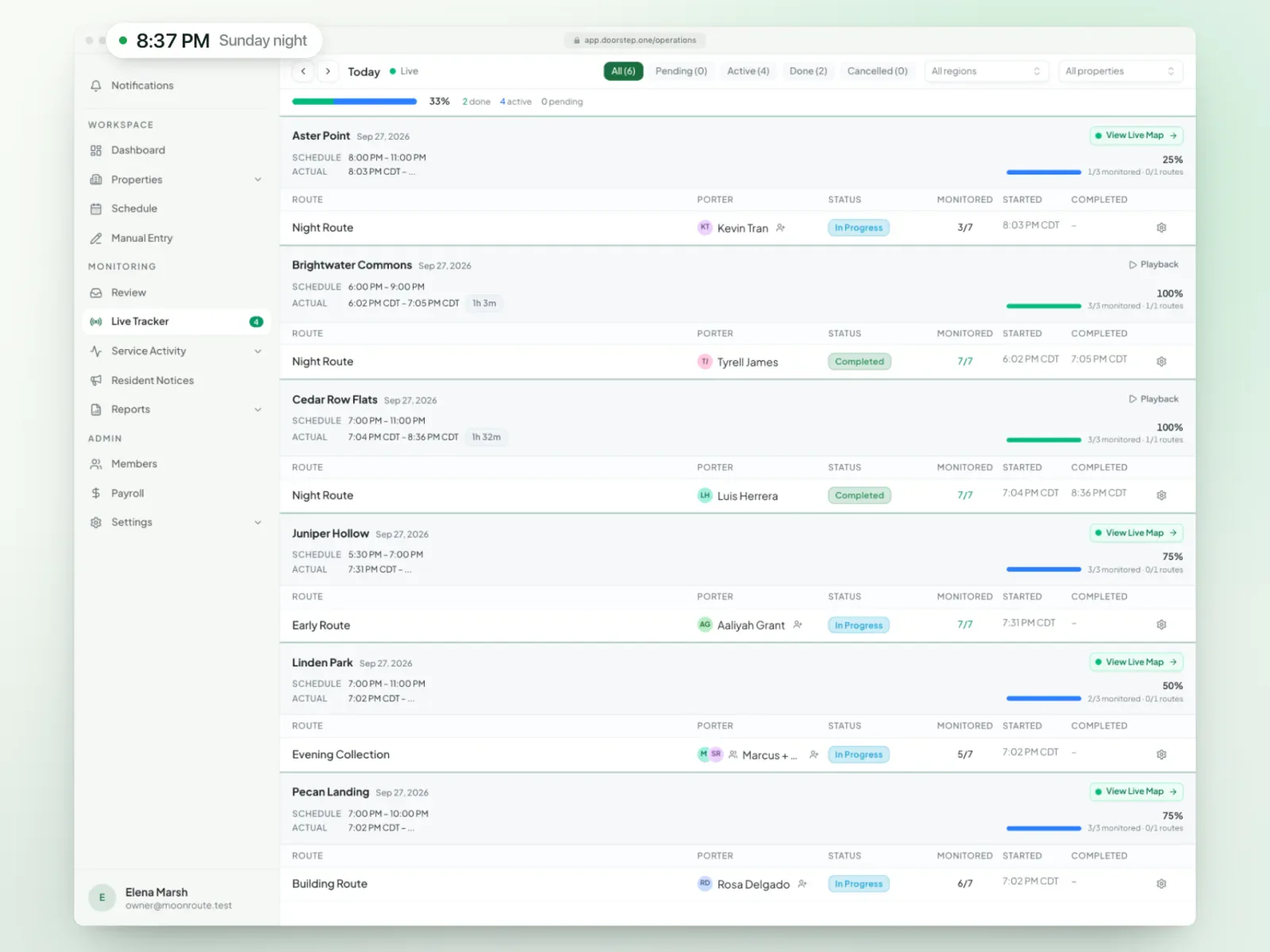
A miss you learn about at 8 AM is a complaint. A miss you learn about at 10 PM is a go-back. Every hour, Doorstep One flags missed routes and pickups, skipped parts of a route, missing photos, off-site work, early starts, routes finished too fast or never finished, and reports that couldn't send — and puts problems in front of the operations team while the porter is still in the field. You find out first, not your property manager.
Supervisors don't need a desk to act on it. The Monitor tab in the mobile app puts properties that need attention at the top, with the photos, a way to call or reassign the porter, and the option to step into the route without taking it over. And if a route is running behind, add a helper from the Live Tracker: the route appears in their app right away, even after it has started, and both porters work one list.
4. Review before the client sees anything (optional)
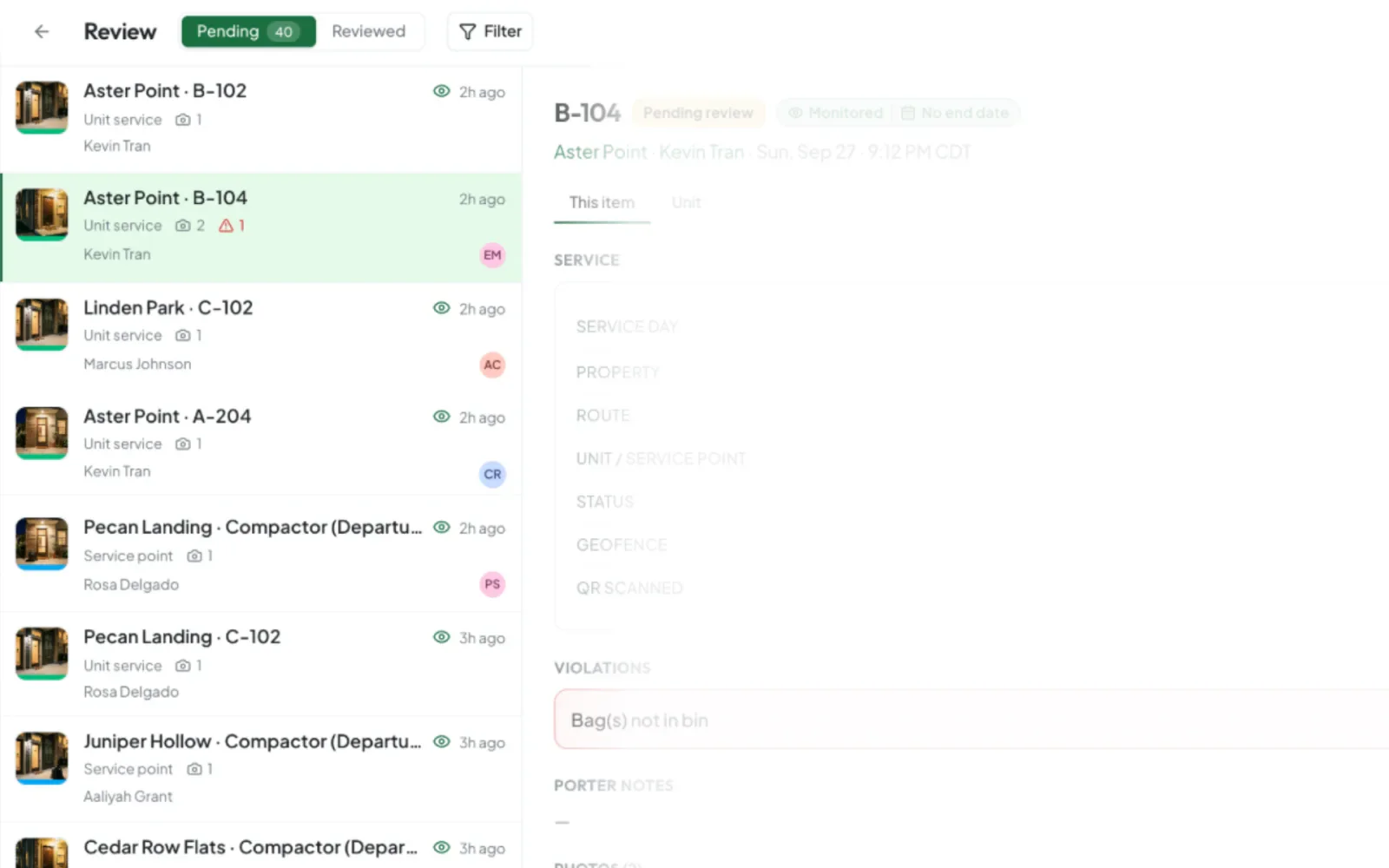
Larger teams add a quality gate: the night's work waits in a review queue where a supervisor approves, rejects, or fixes records before anything reaches a client report. Not every team wants this every night — it's optional — but at portfolio scale it's how you guarantee that only clean evidence represents your company. When a reviewer removes a record, it comes back to the porter's app as a follow-up to redo, and the route waits for it.
5. Send the proof every morning
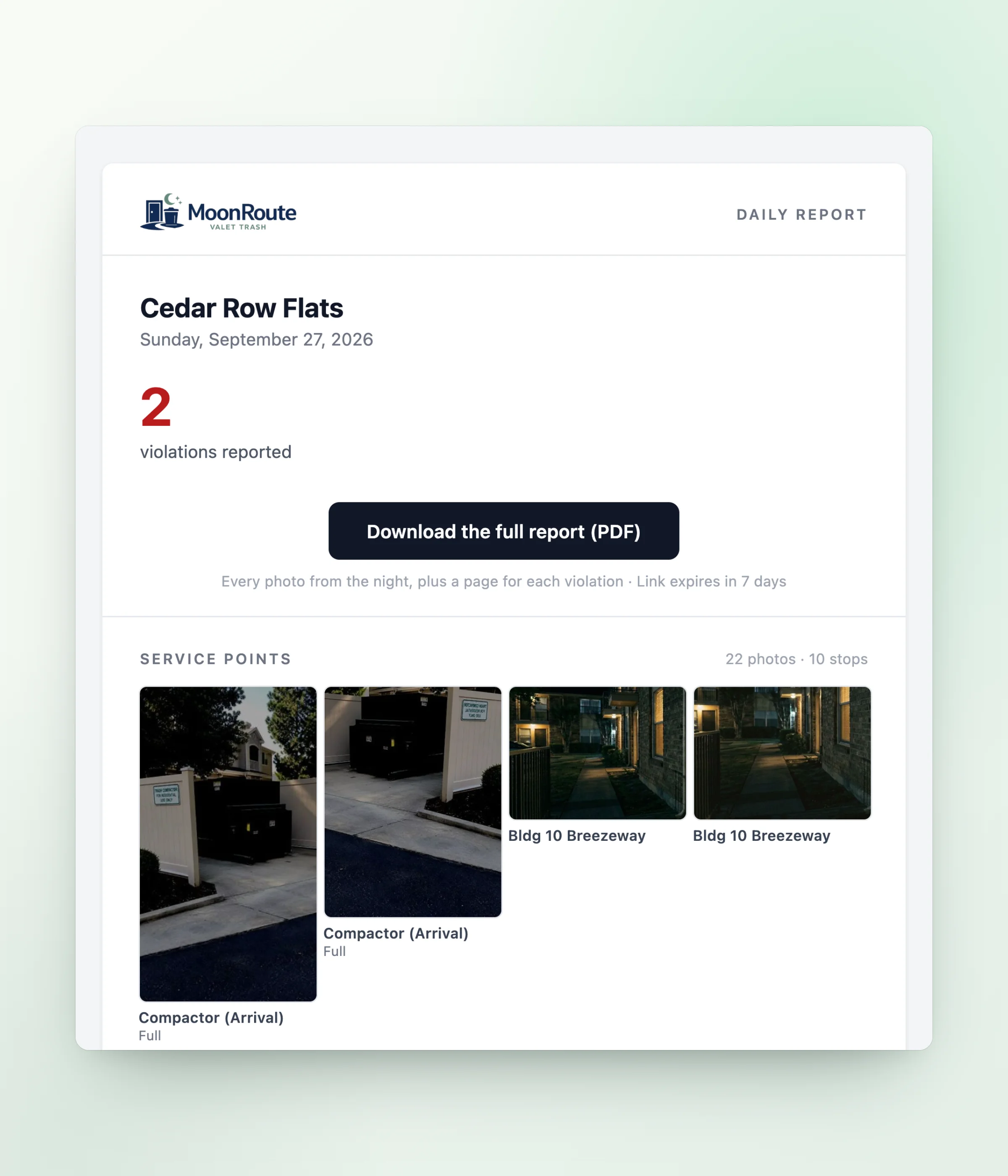
The daily property report — All Clear or the violation count, the night's photos, a PDF — goes out once the night's routes are done, and does two jobs. It gives the property manager the night's record without anyone having to ask, with no week-old mystery to reconstruct. And it builds the trust buffer: a manager who has seen proof arrive every morning for six months treats the occasional miss as an exception, not a pattern. If a route is still unfinished 24 hours later, the report is skipped and your team is told, so a stuck night never goes unnoticed.
When a pickup is actually missed
It happens. What separates professional operators:
- Go back the same night if the route allows it, and log the go-back like any other service so the record shows the recovery, not just the miss.
- Tell the property manager before they tell you. The morning report already carries the evidence; a one-line note from a human turns an incident into a demonstration of your process.
- If a route can't run, say so. Cancel the night with a reason: the property manager sees "not serviced" and why instead of silence, and you choose whether the porter is paid.
- Look for the pattern. One miss is a night. The same building twice is a route-design problem, a staffing problem, or a training problem — fix the system, not the porter.
And when a dispute surfaces weeks later, rebuild the night: which units were monitored, what was collected and photographed, who reviewed it. A record you can replay beats a memory you have to defend.
At portfolio scale, prevention is visibility
With one property, the owner walks the route. With twenty to a hundred, prevention becomes an operations problem: live tracking across every property on one board, supervisors scoped to their own regions, routes that haven't started surfacing while there's time to act, helpers added to a short-handed route mid-night, and an automatic report for every property manager at every property. The chain above is what makes a hundred simultaneous route-nights inspectable by a team of a few people.
Frequently asked questions
- How do I know the same night that a pickup was missed?
- You need two things: a defined evidence expectation (which units and service points must be logged with photos every service night) and something that checks it while the night is still running. Every hour, Doorstep One flags missed routes and pickups, skipped parts of a route, missing photos, off-site work, early starts, routes finished too fast or never finished, and reports that couldn’t send, so the operator finds out before the property manager does.
- A resident says their trash was not picked up. How do I check?
- Pull that night’s record for the unit: its photos, timestamp, and location if the door was monitored or flagged, plus the route’s activity for the night. Most disputes end there — either the record shows the pickup happened, or it shows it did not and you fix it with a go-back and an honest answer.
- What causes most missed pickups?
- Thin staffing (a porter calls out and the route runs short-handed), new porters who do not know a property’s layout yet, and split responsibilities where nobody owns a building. A surprising share of “missed pickups” are actually missing records — the trash was collected, but nothing proves it, which to a property manager is the same thing.
- Do I need software to prevent missed pickups?
- Process comes first: clear route order, a named porter on every route, and a same-night check. Software is what makes that process automatic and provable — required photos on the units and service points you choose, hourly checks, and a morning report mean the process runs even on the nights nobody is watching.