
What Is Valet Trash? How Doorstep Collection Works
Valet trash is one of the few apartment amenities residents use almost every night, and one of the few they only notice when it goes wrong. This guide explains what the service is, how a night actually runs, what a trash porter does, and how valet trash differs from the other services it gets confused with.
What valet trash means
Valet trash is nightly doorstep trash collection at multifamily communities. Instead of walking bags to a dumpster or compactor, residents set their trash outside their door during a set window, and a porter collects it and carries it away. You will also hear it called doorstep trash, doorstep collection, or trash valet; they all describe the same amenity.
Most communities don't run it themselves. A property contracts a valet trash operator, a company that staffs porters, runs the routes, and answers to the property manager for the result. The property usually charges residents for the amenity through a lease addendum, which is why valet trash also shows up in conversations about ancillary income.
How a service night works
A valet trash night has four parts, and every one of them is where service is won or lost.
- Set-out. Residents place bagged trash in a container at their door during the set-out window, commonly 6–8 PM on service nights. Many communities run five nights a week.
- The route. Porters walk the property on a planned route, building by building and floor by floor, collecting from each doorstep and carrying the bags to the compactor or dumpsters. Larger properties may put more than one porter on a route.
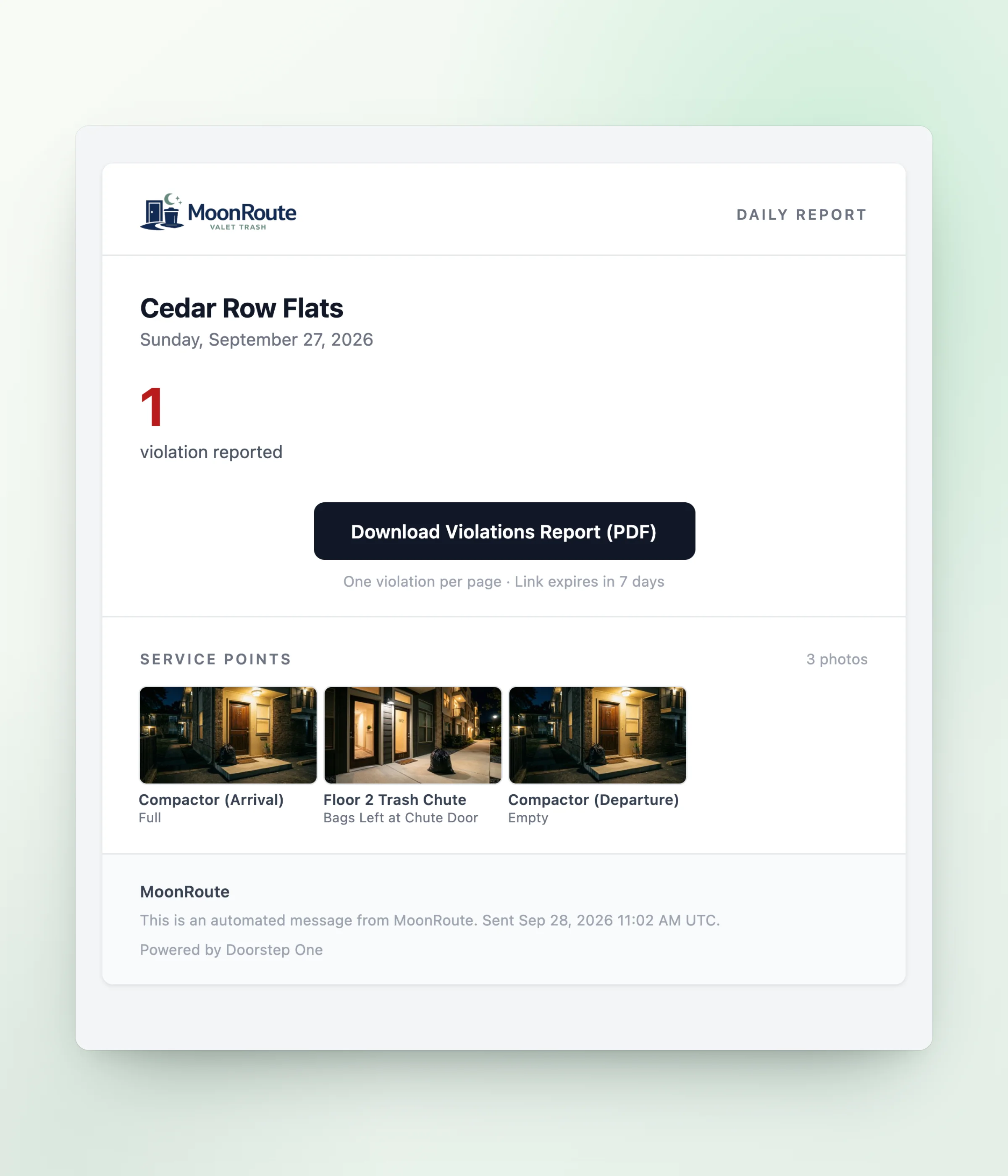
- Violations. When trash goes out early or late, without a bag, leaking, or too big to carry, the porter records a violation with a photo so the property can follow up with the resident.
- Proof. By morning, the property manager should know what happened: that the route ran, which problems were found, and anything that couldn't be serviced. Professional operators send that as a morning report.
What a trash porter does
A porter is the person who runs the route. The job is physical and nightly: stairs, breezeways, parking garages, and a lot of bags. A good porter also knows the property well enough to spot what's wrong, like a bag left out after the window or a compactor that's full, and documents it instead of walking past it.
Operators increasingly equip porters with a phone app that shows tonight's route, takes the photos the property requires, and records violations as they happen, so the proof exists before the porter clocks out. The Doorstep One porter app works that way, in English and Spanish, and keeps working in basements with no signal.
Valet trash vs porter service
The two terms get mixed up because the same companies often provide both, and some crews do both. They are different services with different jobs.
| Valet trash | Porter service | |
|---|---|---|
Where | Every unit’s doorstep | Common areas: hallways, breezeways, amenity spaces, grounds |
When | Evenings, during the set-out window | Usually daytime, on a set schedule |
What | Collecting residents’ bagged trash | Litter pickup, pet stations, common-area trash, and trash-outs of vacant units |
Who it serves | Residents directly, as a paid amenity | The property, as part of keeping the community clean |
How it’s judged | Every night: was my trash collected? | Over time: does the property look cared for? |
If a property manager asks for "porter service," clarify which one they mean before you quote it. Many operators bundle the two, but they are staffed, scheduled, and priced differently.
Valet trash vs curb-to-bin
Curb-to-bin is the single-family and townhome version: a crew moves carts between the curb and the collection point on trash day. Valet trash is multifamily and collects from each door, usually several nights a week. The words overlap in marketing, but the operations don't.
Who pays for valet trash
Two prices are involved. Residents commonly pay the property $25–$35 per unit per month for the amenity, and the property pays its operator a smaller per-door amount for the service. The valet trash pricing guide breaks down both sides and what it costs an operator to deliver.
What property managers expect from a valet trash provider
Property managers rarely switch valet trash providers over price. They switch after the night nobody could explain. What they look for:
- Reliability: the route runs every service night, and missed doors get caught and fixed.
- Proof: time- and GPS-stamped photos of the units and service points that matter, and a record of every violation.
- A report without asking: a clear summary in their inbox the morning after, for every manager on the property.
- Honesty when a night doesn't run: a plain "not serviced" and the reason, instead of silence.
If you are bidding for a contract, the valet trash RFP guide covers how those expectations show up in a proposal.
Running valet trash as an operator
At a handful of properties, an owner can keep all of this in their head. At twenty or more, it needs a system: routes and schedules, a porter app that proves the units and service points that matter, problems caught while the night is still running, and a report that reaches every property manager automatically. That is what Doorstep One is built for, including team routes for the nights that need more than one porter.
Frequently asked questions
- What does valet trash mean?
- Valet trash is nightly doorstep trash collection at apartment communities. Residents set bagged trash outside their door during a set window, and porters collect it and carry it to the property’s compactor or dumpsters. It is also called doorstep trash, doorstep collection, or trash valet.
- What is a trash porter?
- A trash porter is the person who runs the valet trash route: walking the property building by building, collecting from each doorstep, carrying bags to the compactor, and documenting problems like trash set out late or left without a bag. Some providers call them service valets.
- What is the difference between valet trash and porter service?
- Valet trash is the nightly doorstep route: collection from every unit’s door during a set-out window. Porter service usually means common-area upkeep, often in the daytime: hallways, breezeways, amenity areas, litter, pet stations, and trash-outs of vacant units. Many operators offer both, and some crews cover both.
- How much does valet trash cost residents?
- Residents commonly pay the property $25–$35 per unit per month, usually through a lease addendum, and the property pays its valet trash operator a smaller per-door amount. The pricing guide breaks down both sides.
- How do property managers know valet trash actually happened?
- From the operator’s records. A professional operator documents the night with time- and GPS-stamped photos on the units and service points that matter, records every violation, and sends the property manager a report the next morning.