
Valet Trash RFPs: What Property Managers Ask For and How Operators Win
When a management company puts valet trash out to bid, it is rarely because the old provider was too expensive. It is usually because of a night nobody could explain. That shapes how the contract is won: the proposal that shows how every night will be proven beats the one that promises it will be.
This guide covers what a valet trash RFP typically asks for, the handful of questions that actually decide it, and how established operators answer with evidence.
What's usually in a valet trash RFP
Requests for proposal vary by management company, but most cover the same ground:
- Scope: the communities, unit and building counts, service nights, the set-out window, and what is collected: trash, recycling, bulk items, compactor areas.
- Service standards: what counts as a violation, how residents are notified, and how the property is told.
- Reporting: how often, what it contains, and who on the property's team receives it.
- Staffing: how porters are hired, supervised, and identified on site, and what happens when one calls out.
- Insurance and compliance: certificates of insurance and the coverages the property requires.
- Pricing and term: price per door per month, the contract term, and how the transition from the current provider will work.
The questions that actually decide it
Everything above is table stakes. These are the questions the decision turns on, and the answers that win them.
"How will we know service happened?"
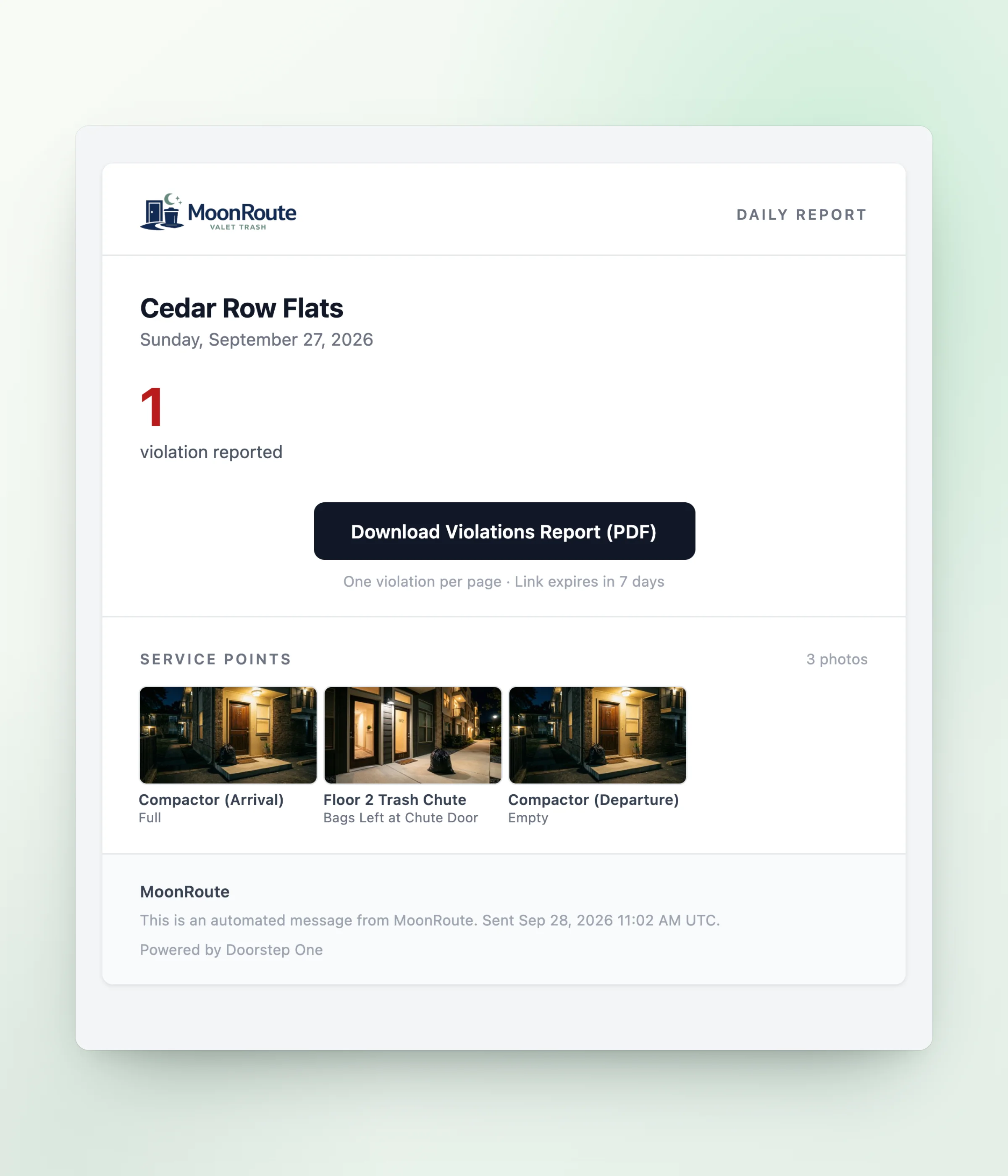
Promising reliable service is table stakes. Showing how you prove it is what wins. Describe exactly what gets documented each night: time- and GPS-stamped photos of the service points the property cares about, such as the compactor before and after service, and a photo on every violation. Then show the report the property manager will receive the next morning.
"Who gets the reports?"
Portfolios have property managers, assistant managers, and regional managers who all want to know about last night. The strongest answer: every one of them gets their own access to only their properties and the morning report by email, automatically, at no cost to the property. Doorstep One does exactly that, with unlimited free property manager logins.
"What happens when a porter doesn't show?"
Name the backup plan: who covers, how fast, and how the property finds out. Operators on Doorstep One can reassign a route or add a helper to tonight's route even after it has started, and a route that hasn't started shows up on the supervisor's phone the same night. When a night genuinely can't run, the property manager sees "not serviced" and the reason, not silence.
"How are violations documented?"
Property managers need violations they can act on. Each record should carry a photo, the unit, the time, and the reason, ideally as a one-page PDF they can forward to the resident. See the violations guide for a documentation standard that holds up.
"How will you catch problems before we do?"
This is where established operators separate from everyone else. Explain how missed doors, skipped parts of a route, missing photos, routes that never started, and routes finished too fast are caught while the night is still running. A miss found at 10 PM is a go-back; a miss found at 8 AM is a complaint. The missed pickup guide covers the prevention chain.
How to answer with evidence instead of promises
- Attach artifacts, not adjectives. A redacted morning report and a violation PDF from a current property say more than a page of "industry-leading service."
- Map the scope to your routes. Show how each community's buildings, service nights, and service points will run, including the compactor and any areas the property calls out.
- Name your checks. List what gets flagged automatically and who acts on it at night.
- Offer a pilot. Proposing to start with one property lowers the switching risk for the management company and lets your first month of reports make the case for the rest.
- Price it honestly. Build the bid from route labor, not from the incumbent's number. The pricing guide has the math.
Questions property managers should ask any valet trash provider
If you are on the property side, these ten questions separate a professional operator from everyone else:
- What exactly is documented each service night, and with what evidence?
- Can I see a real morning report from a current property?
- Who on my team receives the report, and can each of us log in separately?
- How are violations recorded, and what can I forward to a resident?
- What happens when a porter calls out or a route runs late?
- How do you find out about a missed door, and how fast?
- How will you tell me when a night isn't serviced, and why?
- How are porters supervised on site?
- Can you pull the record for one unit on one night if a resident complains?
- What does the transition from our current provider look like?
Where Doorstep One helps
Doorstep One is the software established operators use to answer every one of those questions with evidence: routes and live operations for the office, a porter app that proves the stops you choose, problems flagged hourly, and a morning report for every property manager, free. Book a demo with an RFP in hand and we'll show you the report your prospect will receive.
Frequently asked questions
- What should a valet trash RFP include?
- The communities and unit counts, service nights and set-out window, what is collected (trash, recycling, bulk items), how violations are documented and reported, the reporting the property expects and who receives it, staffing and backup coverage, insurance requirements, pricing per door per month, and the contract term.
- What questions should I ask a valet trash company?
- Ask how you will know service happened each night, what the morning report contains and who receives it, how violations are documented, what happens when a porter doesn’t show, how problems are caught before you notice them, and how they will tell you when a night doesn’t run. Ask to see a real report, not a description of one.
- How do operators price a valet trash bid?
- Usually per door per month for a set number of service nights, built from the labor cost of each route-night plus supplies, insurance, software, and margin. The pricing guide walks through the math.
- What reporting should a valet trash provider give property managers?
- A report every morning after a service night, without having to ask: whether anything needs attention, photos of the service points the property cares about, and a record of every violation that can be forwarded to the resident. Every manager on the property should receive it.